

Imagery has always been a very powerful tool in marketing processed foods. When regulations get in the way of what manufacturers want to say, the use of iconic symbols and imagery has helped them bypass most restrictions in their quest to elevate their products and obscure reality.
One of the most compelling symbols in existence is the sun. Since the dawn of mankind, it has been associated with a life-giving force. In many ways the sun is the very essence of nature. So it shouldn’t be surprising to see this symbol crop up frequently in packaging and advertising for processed foods.
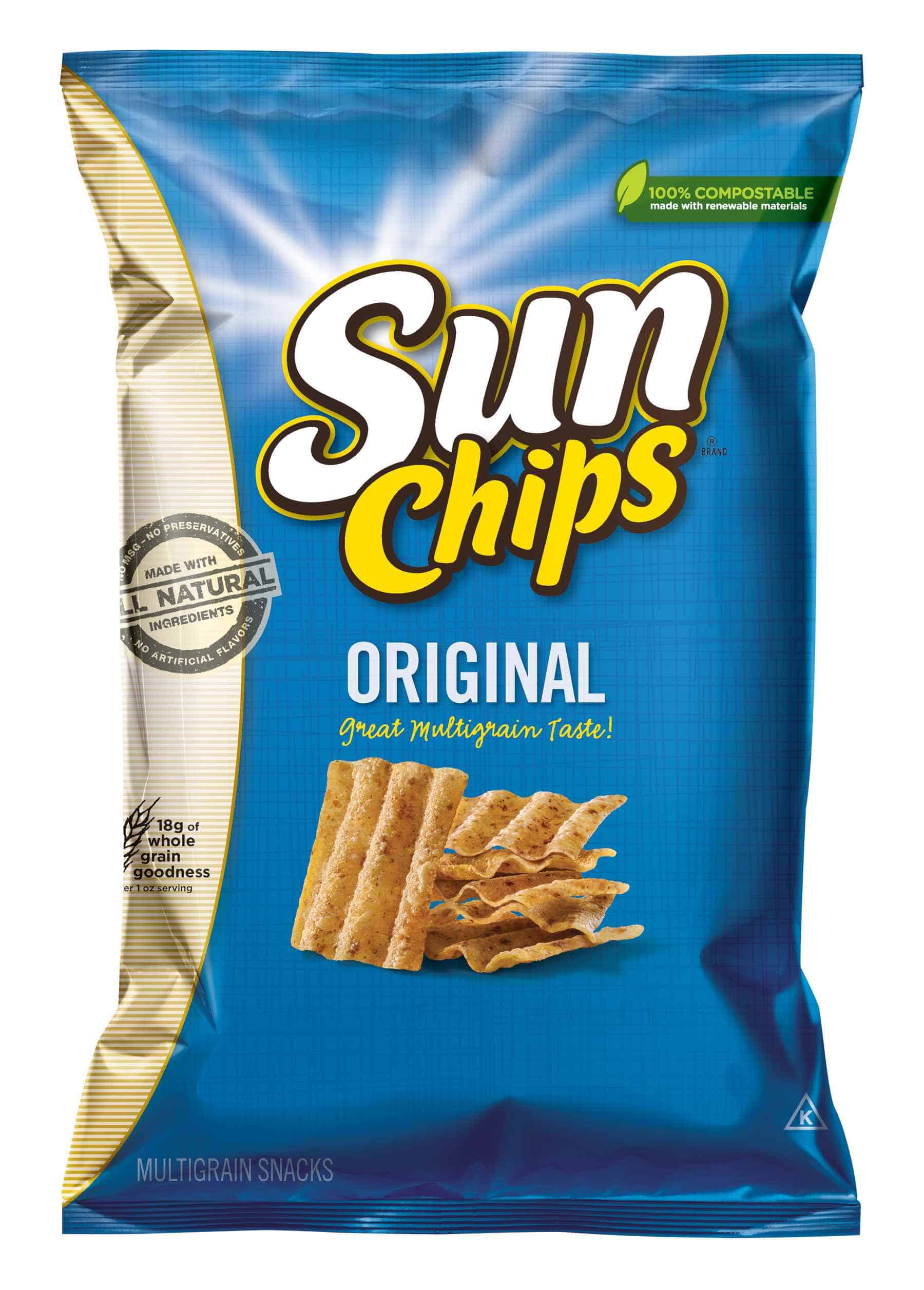
Sun Chips is a prime example of a brand that taps into the power of the sun. Launched in 1991 as a healthier snacking choice, Frito-Lay has continued to build Sun Chips’ better for you, wholesome brand image. Check out this commercial from a couple years ago and see how the magic of advertising works:
*|YOUTUBE:WvKwJHWigqQ:300|*
Visuals of sunlight, fields of wholesome grain, and picturesque landscapes provide compelling imagery that works subconsciously and lays the foundation for beliefs that Sun Chips are a healthier, more natural snack. In addition to these visual cues, Frito-Lay now bursts “All Natural” on Sun Chips’ packages and also makes several back panel claims: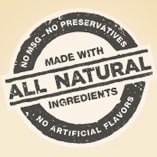
- No artificial flavors
- No preservatives
- No MSG
- 0g trans fat
- 18g of whole grains per 1 oz. serving
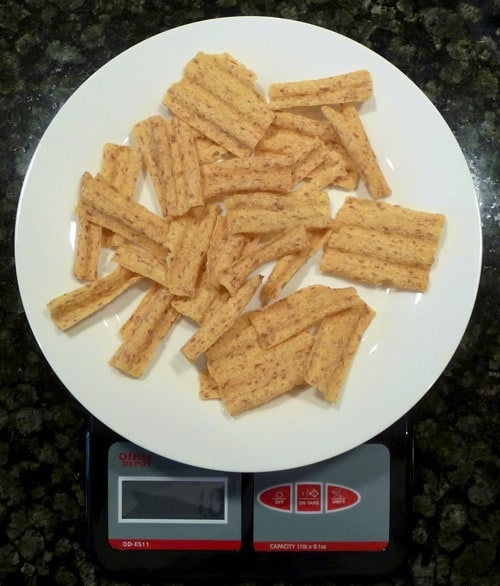
But is the Sun Chips story really so sunny? Unfortunately the answer is “no.” Although Sun Chips may be healthier than some of their salty snack brethren, that really isn’t a very hard mountain to climb. With 140 calories, 6 grams of fat, and 120mg of sodium in a 1 ounce serving, snacking regularly on Sun Chips probably will lead to some long-term trouble. And when you consider how few chips there are in a 1 ounce serving (see below), you realize that an average Sun Chips snacking session is likely to have at least two or three times the calories, fat, and sodium.
Besides it’s dubious nutritional profile, there are several ingredients that don’t seem consistent with Sun Chips’s “All Natural” claim:
- Whole corn: If you’ve been reading my “All Natural … Really?” series very long, I’m sure you guessed it–this is GM corn (genetically modified)–hardly all natural in my book.
- Natural Flavor: This sounds like an innocent enough ingredient, but as Eric Schlosser points out in his book Fast Food Nation, “The distinction between artificial and natural flavors can be somewhat arbitrary and absurd based more on how the flavor has been made than on what it actually contains…. A natural flavor is not necessarily healthier or purer than an artificial one.” Natural Flavors are also closely guarded secrets of manufacturers and flavor houses. My request for more detail on exactly what is in Sun Chips’ natural flavors has yet to be answered, but rest assured, if it’s revealed, it’s most likely a list of complex chemical compounds that would double or triple the length of the ingredient panel.
- Maltodextrin: In the case of Sun Chips, maltodextrin has been enzymatically derived from GM corn. The result is a bland to slightly sweet additive that is a staple in processed food. To me, maltodextrin is to starch what high fructose corn syrup is to sugar: a highly processed, man-made concoction that bears no resemblance to its raw ingredient forebears. Although it is easily digested by most people, if you’re having gastrointestinal issues, monitor your consumption of maltodextrin since in some cases it has been known to cause extreme GI issues.
- Never eat out of the bag, it’s just too dangerous. If you’re going to indulge, get out a small bowl and control your portion.
- Try replacing a serving or two a week with a serving of cut up veggies. Then each week, replace another of your salty snack servings with veggies until you’ve reduced your addiction to an occasional treat. A piece of fruit like an apple is also a good replacement option.
- Good quality nuts are also a good alternative. But you’ve got to remember, nuts are packed with calories–a little goes a long way. So don’t go bingeing on the whole bag or jar.
As always, if you’ve enjoyed this post, please share it by pasting a link on your Facebook wall, liking it, or emailing it to a friend. And for more inside scoop on the world of food, please subscribe to my blog.



19 Responses
Mixing Imperial and metric measures – 18g of whatever in 1oz of whatever – is really shameful. Like someone thought “How can I share information, but render it effectively meaningless.” You’ve got to be a pretty poor piece of work to think of something like that.
Thanks for your comment Tim. I agree. Let’s not ever be mistaken. The objective of the processed food industry isn’t to give an accurate perception of what’s truly IN any given product. Rather, food companies are only concerned about driving sales, so they will work dutifully to research different claims in hopes of maximizing brand growth. Truly educating a consumer is rarely if ever on their radar.
I may be one of the few members of the Canadian generation (early 1980’s) who were in elementary school during the phasing out of the Imperial measurements and introduction of the metric system. For me, it is easy to work in either system. I’ll run a 10 K at a 10 minute mile pace 😉
But to use both systems on one food label is truly annoying, and it seems deliberately planned to make it impossible for the average consumer to quickly make a good shopping decision at the store.
Thanks for your comment Anthea. I totally agree. Unlike you, I have to pull out my calculator or metric converter on my phone to be able to make sense of it. In general, a good rule of thumb is to “think critically” and never believe at face value any claims made by food manufacturers.
Keep the comments coming. Thanks again for participating on my blog!
Hi- I wonder could you use those same sophisticated,flashy marketing & packaging tools to efficiently,accurately, & effectively market minimally processed, low margin good-for-you products ???
I’ve seen indra-nooyi/ pepsi ceo [who evolved out of India] make a distinction
” Our belief is the following: There’s always going to be a market and a terrific market for fun-for-you, better-for-you products because people always want to have a moment of fun and want a moment of indulgence, and you’re never going to tell them not to do that because it is just fine to have all of those products.
But there’s also a growing market, and that market for good-for-you products is growing about three times as much as the market for fun-for-you products. And these are products that give you positive nutrition like fruit and vegetables, grains, protein, these markets are growing 8, 9 percent a year in the developed world.
source:http://management.fortune.cnn.com/2011/10/05/pepsi-indra-nooyi/
Yes…the sun is being “used” and abused. I wish Mother Nature could exact revenge. And, don’t forget these toppers of the Sun-Abusers List: SunnyD and SunKist!!
Love your blogs.
General Healthy
I mean, the post has some generally fair points. Clearly marketing is desiigned to sell, which often involves clever deception. But it’s so pervasive and so acceptable that consumers really shouldnt be surprised at this point. If you don’t know that a snack sold alongside cheese puffs and bean dip is not healthy, then you’re doing it wrong. So your reporting on this “news” seems rather patronizing.
In any event, I only wanted to comment because this website, or the platform on which it is based, has an absolutely infuriating mobile experience. I can’t even see what I am typing on my iPhone because the screen is covered. Ompletely by buttons, overlays, share widgets, and such. They just fly out over the text while I am reading, too. Likely not your fault, but I thought you should know. Now to figure out how to submit amid all this chaos…
Thanks for your comment, AJ. Unfortunately many people aren’t as “aware” of how marketing manipulates and deceives them. We can hope though!
Regarding your technical problems with my blog, my apologies. I’m looking into your concerns immediately and hope to have some solutions to address them.
Thanks,
Bruce
As a nutritionist once told me, “Never trust a company to tell you that their product is good for you.” You have to be proactive and do the research yourself, especially concerning the foods you feed your children.
Food companies are driven by greed. Greed is the essence of Western society, especially America. We legitimatize many things in order to sell. Even this website, with its onslaught of side bars, is a reflection of this overindulgence – addiction – to sell. And to what end? Accumulation of wealth.
Financial obesity.
Is there any escape? Every endeavor is being consumed by this voracious appetite of I want more money for myself and I will disguise it in the form of convincing you I am giving you want you want.
So we pick our battles. We all fail. This site tries to give information on healthy and capitalizing or monetize that by making the site “free” while inundating the user with attempts to sell.
For most, being massaged by the medium – by all culture! – in this manner has become so normalized that we don’t notice how nefarious it is.
Hence, everything has become another ploy to sell. This is the gift that U.S. has given the world.
Well that’s how the free market works. There may be subliminal marketing driven by greed, but in examples, such as this site you brought up, you don’t have to visit it.
I would hardly call this blogger having a few ads on his site participation in a model of greed. He probably makes a few extra bucks off ads, that’s it. What if he’s just trying to make enough money to sustain himself or his family, by getting out information that is important to a lot of people, and in the process has a few ads up? How is that selfish or greed?
Hi Bruce,
This is my first time reading your blog so forgive me if I missed something. My question is, how do you know the corn is GM? I couldn’t find anything on the package- were you able to get in touch with SunChips and confirm this or is it an assumption given the amount of genetically modified foods around today? Thanks, great article.
Hi Will. Thanks for your comment. Unfortunately GMOs are not required to be labeled in the US (over 60 countries do require GMO labeling and almost all industrialized nations except for the US). So, in order to tell if the corn is GM, you must choose organic products or look for a made with non-GMO project label. Here’s a link to what that label looks like: http://www.nongmoproject.org
Hope that helps!
Bruce
As an occasional treat I don’t see any problem eating a small bag of Sun Chips, especially when compared to other snack food items commonly available.
You can over indulge in anything. You have to eat in moderation of any food..personally i developed a love for sunchips..they are a whole grain option and do have lesser calories than a snack of potatoe chips ive had in the past. With the food industry a lot of things are processed..but its a balancing act and you must eat a good share of fruits and veggies beside a 1 ounce bag of sunchips every day…thanks for your blog.
The appeal for me is the fiber content (4g) in a 1.5oz bag, and the decent amount of mono/polyunsaturated fats.
The bag strangely doesn’t list those anymore, although there is sunflower oil and the website does for some flavors. I don’t know which is the true nutritional value source, but if a call to them reveals nothing, I will stop eating them.
yo stop messing up my sunchips???????
what’s wrong with GM corn?
Here’s a recent article that outlines many of the dangers of GMOs: https://www.forbes.com/sites/erikkobayashisolomon/2019/02/15/heres-the-real-reason-why-gmos-are-bad-and-why-they-may-save-humanity/#8272d1e4877b