

Food companies are some of the savviest trend spotters around. They literally spend Hundreds of MILLIONS of dollars tracking and following trends. In fact, in some cases, they even help create the trends. Why? It’s all in hopes of selling more and more food. But when simple foods and short ingredient lists became the latest trend, did Big Food run scared? No–they did just the opposite. LIke a chameleon, they quickly adapted and turned the trend to their advantage.
Does that mean our food is really simpler? In some cases, yes. But more often than not, Big Food has merely hijacked this trend and leanwashed the truth so it can sell more food. Don’t believe me? Let’s take a look at a real life example to see Big Food hard at work.
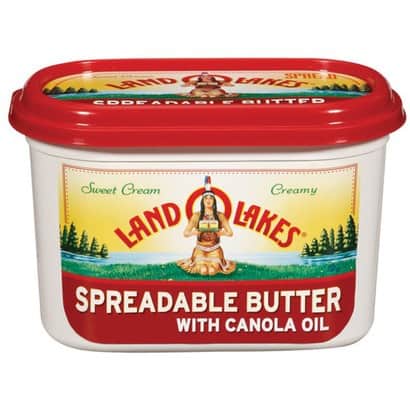
I don’t know about you, but I’ve loved butter since I was a kid. When used sparingly, it’s a delicious complement to so many different foods. But over the years, butter manufacturers like Land O’ Lakes lost out as consumers drifted to spreadable margarine thanks to powerful health and convenience trends. Yes, butter manufacturers tried to fight back with whipped butter, but it just didn’t have have that smooth, easy to spread texture of tub margarine. Fast forward to 2003, Land O’ Lakes launched a new, spreadable butter that blended canola oil into butter to make it softer even when it’s cold. And when this invention got paired with the trend towards simpler, cleaner ingredient labels (unlike those on margarine), advertising like this bubbled up to exploit the trend:
With the ease and convenience of spreadability, three natural ingredients, and a tagline like “where simple goodness begins,” Land O’ Lakes spreadable butter sounds downright perfect, right? The sad truth is that while simple and natural ingredients can give the appearance of purity and goodness, you have to look deeper. In the case of Land O’ Lakes Spreadable Butter with Canola Oil, two ingredients caught my attention:
Sweet cream is a very pure, simple-sounding ingredient on a label. But in the United States, many dairy products are sourced from cows that are treated with growth hormones (like rBGH). These hormones are used to increase milk production and have been approved by the FDA (thanks to lobbying from the likes of Monsanto). But for good reason, not everyone is a fan. In fact, the United States is the only developed nation that permits its people to consume milk from cows treated with rBGH growth hormones. And a 2010 U.S. Court of Appeals decision acknowledged that milk from rBGH-treated cows varies from untreated cow’s milk in three ways that have real significance to consumers:
- Higher levels of IGF-1: IGF-1 is a hormone that allows certain cells to grow. As the American Cancer Society reports, “Several studies have found that IGF-1 levels at the high end of the normal range may influence the development of certain tumors.” Although the scientific evidence is inconclusive at this time, the American Cancer Society goes on to say “more research is needed to help better address these concerns.” I don’t know about you, but I’d rather this research be done before a product is invisibly foisted into our food supply and called natural and simple. What do you think?
- Milk of lower nutritional quality: During certain periods of lactation, the milk produced by dairy cows treated with rBGH has decreased levels of proteins and higher fat content, indicators of lower quality.
- More pus in milk: Cows treated with rBGH endure many harmful side effects including mastitis, an infection of the udder. These infections lead to not only more pus in our milk, but also the increased use of antibiotics to ward off infections. Call me crazy but pus and antibiotics are two things I’m trying to cut back on in my diet.
Canola Oil is the second ingredient that caught my attention. Although billed as a natural, heart-healthy oil, the truth is the majority of canola is derived from genetically-modified rapeseed. If GMO concerns aren’t enough to make you blink, then consider this: most commercially produced canola oil is very highly processed and undergoes intensive manufacturing steps like being refined with hexane and then bleached. Does this sound simple or natural to you?
To confirm my suspicions, I emailed Land O’Lakes to see if its spreadable butter used rBGH treated milk and/or GMO canola oil. At first they dodged the question and instead blathered on and on with sentiments like this: “Land O’ Lakes, Inc. believes the environment has been increasingly better served by advances in technology.” [you can read the full text of their reply here] Finally, after asking again, I got this reply: “The ingredients used in LAND O LAKES® Spreadable Butter with Canola Oil are not hormone or GMO free.” Huh, it’s as simple as that. While Land O’ Lakes spreadable butter may not appear to have the long list of chemicals that are in most margarines, it’s not nearly as pure, simple, or natural as it pretends to be.
So what can we do? Be vigilant, ask questions, and dig for the truth. You see, Big Food companies simply cannot be trusted to disclose all the information we want to know about our food. Although their disingenuous approach must change, for the time being we must assume that every time Big Food speaks, they are trying to sell us something, not provide us with the complete story. And if you’re looking for a little extra help, check out my series All Natural…Really? where I explore foods that pretend to be natural or simple.
And how about your butter? Well if you’re looking for a replacement for your spreadable butter, here’s what I do. I buy organic butter. If I want some to be soft and spreadable, I use an old-fashioned butter keeper–you can find a wide selection of them online.
As always, if you’ve enjoyed this post, please share it by pasting a link on your Facebook wall, liking it, or emailing it to a friend. And for more inside scoop on the world of food, please subscribe to my blog.

19 Responses
As usual, a great read. When I first moved to the US from Italy in 2005, I recall being appalled to see that it was not growth hormone users who had to disclaim that their milk was comparable to untreated, but the other way around: non-users must declare that their milk isnt’t scientifically proven to be better. I cannot begin to describe how upside-down this approach still feels to me
Agreed, Stefano. Things are messed up here in the states!
Thanks for reading and commenting on my blog! Glad you’re enjoying it!
As always, direct responsibility is best. Buy your food directly from your farmer. realmilk.com is a great place to start.
I’ve been using Earth Balance Organic Coconut Spread. Works just like butter for cooking and baking: http://www.earthbalancenatural.com/product/organic-coconut-butter
Earth Balance also makes a fantastic non-GMO peanut butter.
Thanks, St. McDuck. Great advice for those looking for a non-dairy alternative!
Once again, I am thoroughly satisfied by your blog post. Thanks for being such a good writer and posting about interesting topics! My family loves this butter but I never was a fan. Now I have some real reasons behind my skepticism!
Thanks for your comment, Tanya. I’m glad you enjoyed my blog post and found it informative! As they say, information is power, and I hope to shine the light on some of the stuff Big Food likes to hide. Hopefully you and my other readers can help spread the word so we all can be vigilant and fight to know what’s in our food!
Thanks again for reading my blog!
Canola oil is toxic to your liver, and a trans fat because of the way it is processed. I have been writing about this issue for many years now. Glad to see some one else writing about the risks of canola oil too.
As far as rGBH goes it too has an extended history –
Eli Lilly is Milking Cancer
Eli Lilly is the only company in the world making and distributing rBGH, an artificial growth hormone found in many dairy products that is linked to increased risk of breast cancer. Eli Lilly also manufactures drugs to “prevent” and treat breast cancer. That’s a highly lucrative profit cycle and one we call pinkwashing. We want to get rBGH out of our food supply completely, and we need your help to do it. Help keep the pressure on Eli Lilly — tell them to sign BCAction’s Pledge to Prevent Pinkwashing.
I just found your blog through 100daysofrealfood.com, and I am already engrossed with it. I love the fact that you once worked for Big Food and decided to speak out about it.
After reading the letter from Land O’Lakes, it saddens me that they would outright lie about the testing that the FDA supposedly has in place. The FDA leaves it up to the producing companies to satisfy their VERY limited requirements. And Big Food would do everything they could to hide any negative finds if it means that the results could affect their bottom line.
Thank you for the information and for what you are doing. I can’t wait to read more over the holiday weekend.
I was wondering if land-o-lakes spreadable butter with olive oil suffers the same fate as this butter? Thanks
Hi! Thanks for your comment. Land-O-Lakes spreadable butter with olive oil might be a little better than the version with Canola since olive oil isn’t GMO.
Hope that helps and thanks for visiting my blog!
Bruce
The skepticism is important, but should be prefaced with an appreciation of the progress made due to heightened consumer health consciousness, which has led to demand for healthier products with simpler ingredients that has been addressed by products like this. The manufacturer never claimed it was non-GMO, antibiotic-free. And everyone can’t afford high-quality organic like you. While not perfect, for most people, this is an accessible, affordable option that Consumer Reports endorsed as one of the best alternatives to regular butter.
http://www.consumerreports.org/cro/butter-substitutes/buying-guide.htm
Christian:
I disagree with you. Consumers do not believe products that are made with GMOs are natural. Similarly, consumers don’t believe that dairy products made from milk produced from cows pumped with antibiotics or growth hormones are “natural.” Food companies take advantage of FDA regulations regarding products labeled “natural”—regulations that the food companies lobbied for in order to mislead consumers. Those are the facts, plain and simple.
While Consumer Reports may recommend the taste of this product, here is what it has to say about GMOs. Dr. Michael Hansen (Consumer Reports GMO expert), who has been studying GMOs for over 20 years says, “We don’t know how safe or unsafe they are, so people are part of an experiment right now. Known allergens increasing, reproductive problems, problems with the gut, and digestive system and also increased tumor productions as well.” Doesn’t sounds like a hearty endorsement for products that contain GMO ingredients, does it? That said, given the prevalence of GMOs (they’re in 75% – 90% of all foods in grocery stores), Consumer Reports wouldn’t have many products to rate if they excluded foods that were made with GMOs.
Thanks,
Bruce
Read more: http://www.myfoxchicago.com/story/22199161/gmo-foods#ixzz2k6HelTzI
I am saddened to see silly anti GMO rhetoric mixed in with actual concern about rBST. Everything we eat has been genetically modified by thousands of years of selective breeding and there is nothing inherently wrong with accelerating that process in a lab. If ever there was a genetically modified food product it is cows milk. Cows milk as an industrial agricultural product barely resembles the substance produced by an Auroch (the now extinct parent species from which we bred cattle)
As for rBST, it is a problem for the cattle themselves, not the customer. The hormone forces production of milk to excessive levels and stresses the cattle. This stress and the negative effect on the animals health is the reason rBST was banned in Canada. IGF levels vary naturally in milk, puss (simply white blood cells) is centrifuged out, and all milk is tested for antibiotics. The negative effects on the cattle does lead to sickness and early death for the animal, but not for the consumer.
You can purchase cold pressed canola oil which is hexane free, but it makes no difference to the consumer because the solvent is recovered. If you want to make an intelligent shot at canola oil, feel free to discuss the fatty acid profile and how the ultra high stability oil is a less desirable substrate for incorporation into cellular membranes. Canola oil (bred for hot deep fryers, not healthy cell function) may yet prove to be a heath problem.
I never said anything about the product being “natural” or anyone thinking it is. And the product doesn’t claim to be “natural” or GMO-free. My point was: Land-O-Lake’s butter with Canola Oil is a step in the right direction in response to demand from consumers for healthier products. Its lower in saturated fat and cholesterol compared to Land-O-Lake’s own salted butter. Land-O-Lakes Butter with Olive Oil is also lower in saturated fat and cholesterol and olive oil is non-GMO, but you’re more likely to find the canola oil version at the grocery store (including the “light” butter with canola oil, which is even lower in fat, saturated fat, and cholesterol).
“That said, given the prevalence of GMOs (they’re in 75% – 90% of all foods in grocery stores), Consumer Reports wouldn’t have many products to rate if they excluded foods that were made with GMOs.”
And everyday people wouldn’t have many products to buy if they took up your impractical suggestion to buy organic, GMO-free. Consumer Reports sensibly takes a variety of factors into account, including taste, nutrition, and price. And the conclusion is that for most people, this is one the best alternatives to regular butter at the grocery store. Not ideal, not “natural” and GMO-free, but one of the better options for most people at the moment.
I do not like this review. Sir, you are a fear monger.
lol, no kidding, he prefers to eat saturated fats instead and his neighbors cow milk probably laced with feces. I work for an international Big Food company that bends over backwards in regard to the best processes known to man regarding good health. I don’t appreciate some of these backwoods assumptions.
Hi Bruce, thanks for attempting to get correct information to dairy consumers. LandOLakes responded by saying they test milk for antibiotics. I’m sure they do. The truth is organic dairy cows are permanently removed from the herd while conventional dairy cows who need antibiotics are removed from the herd for a length of time determined by the FDA. As a registered dietitian, I do not always agree with FDA guidelines as you do not. Yet the truth is, they are removed. For LandOLakes to then continue testing is admirable.
I believe we all must be informed consumers yet consumers have wide avenues to information, and often it’s erroneous.
There is no comparison to some European Butter and there is a big difference in taste and texture. I would give anything if the FDA would ban Monsanto and the vaccinations of animals. I know this will never happen during my lifetime but for the future of the world population to continue it needs to disappear into oblivion. There are too much sickness because of all this genetic modification all the food, people were healthier before it appeared on the market. Monsanto needs to be taken down to stop all the sickness they have caused.